
Affiliate disclosure: This article may contain links to third-party tools or services. Testheon may earn a commission from qualifying purchases in the future, at no additional cost to you. Recommendations are based on technical relevance, not commission potential.
A checkout test fails in CI.
The application code has not changed. The API is responding normally. The payment service is available.
Yet one test worker has already used the only active promotional code. Another worker has changed the customer’s subscription status. A third test deletes an order that a parallel test is still trying to validate.
The test report calls these application defects.
They are not.
They are test data management failures.
Modern QA teams invest heavily in automation frameworks, CI/CD pipelines, cloud browsers, observability, and AI-assisted testing. But many still treat test data as something testers manually prepare before execution.
That approach stops working when test suites become larger, environments become shared, privacy requirements become stricter, and hundreds of tests begin running in parallel.
Test data is not simply an input file or a copied database.
It is a dependency of the entire test system.
A mature test data management strategy helps teams create the right data, protect sensitive information, isolate parallel tests, reproduce failures, cover meaningful business scenarios, and clean up reliably after execution.
This guide explains how to build that strategy.
Key Takeaways
- Test data management is broader than data generation. It includes discovering, creating, transforming, validating, provisioning, isolating, versioning, resetting, and retiring test data.
- Production-like data is not automatically good test data. It can create privacy risks, contain irrelevant volume, and still miss the exact edge cases your tests need.
- A test is not reproducible unless its data state is reproducible. Dataset versions, scenario identifiers, generator versions, and random seeds should be recorded alongside test results.
- Parallel testing requires isolated or reserved data. Shared customers, accounts, orders, inventory, and environments are common causes of flaky tests.
- Not every team needs an enterprise TDM platform. Small teams can often start with data factories, API builders, deterministic fixtures, and disposable databases.
- The strongest strategy usually combines multiple techniques. A team may use masked reference data, synthetic customers, factory-created transactions, and ephemeral environments within the same pipeline.
What Is Test Data Management?
Test data management, commonly shortened to TDM, is the controlled process of creating, sourcing, transforming, validating, delivering, maintaining, and retiring the data required for software testing.
It answers questions such as:
- What data does this test require?
- Where should that data come from?
- Does it contain sensitive information?
- Can two tests safely use it at the same time?
- Can the same data state be recreated after a failure?
- Does it represent the business scenario accurately?
- How will it be cleaned up?
- Who owns the dataset and its rules?
- How do we know when it has become outdated?
A complete TDM process covers the entire lifecycle of test data, not only the moment when data is generated.
Test data management is not test management
These terms are often confused.
| Area | What it manages | Examples |
|---|---|---|
| Test data management | Data states required by testing | Customers, accounts, orders, policies, permissions, transactions, files and events |
| Test management | Test planning and execution | Test cases, runs, defects, coverage, reports and traceability |
| Test environment management | Infrastructure and application environments | Servers, databases, services, deployments, configurations and dependencies |
A test management tool may store test cases and execution results. It does not necessarily create safe, isolated and reproducible customer or transaction data.
Similarly, an environment may be available and healthy while the data inside it is unusable.
For example:
- the application is deployed correctly;
- the database connection works;
- all services are running;
- but no active customer exists with the required subscription;
- or every available account has already been modified by another test.
That is a test data problem, not an environment problem.
Why Test Data Becomes a Hidden QA Bottleneck
Test data problems often appear as unrelated testing problems.
A team may describe its issues as:
- flaky automation;
- slow regression execution;
- unstable staging;
- unexplained CI failures;
- missing test coverage;
- long environment wait times;
- inconsistent results;
- privacy concerns;
- difficult defect reproduction.
But unmanaged data may be the underlying cause.
1. Testers wait for data
A tester needs a customer with:
- an expired subscription;
- two pending invoices;
- a failed payment;
- a specific permission;
- a completed migration;
- an active discount.
Creating that state manually may require navigating multiple interfaces, coordinating with another team, or requesting help from a database administrator.
When data preparation takes longer than test execution, automation alone cannot speed up delivery.
2. Shared data creates false failures
A common automation pattern is to reuse the same predefined users:
standard_user
admin_user
premium_customer
expired_customer
This works while tests run serially.
Once the suite runs in parallel, multiple workers may:
- update the same user;
- reset the same password;
- consume the same discount;
- modify the same order;
- delete the same record;
- lock the same account.
The resulting failures are often blamed on the test framework or application.
3. Production copies create privacy and security risks
Copying production data into staging is attractive because it appears realistic.
But production datasets may contain:
- names;
- phone numbers;
- email addresses;
- financial details;
- payment identifiers;
- medical information;
- credentials;
- API tokens;
- internal business data;
- confidential documents.
Lower environments frequently have broader access, weaker monitoring and less restrictive retention policies than production.
That makes production-derived test data a serious security and governance concern.
4. Test data becomes stale
A “golden database” may be created once and reused for months.
Meanwhile:
- the schema changes;
- business rules evolve;
- new fields are introduced;
- reference data expires;
- production distributions shift;
- migration scripts change;
- new edge cases appear.
The tests may continue passing against a data state that no longer represents the application.
5. Real data still misses important scenarios
Production data can be realistic and still be poor for testing.
It may not contain:
- the maximum permitted value;
- leap-day dates;
- expired tokens;
- duplicate identities;
- unusual character sets;
- very long names;
- rare permission combinations;
- corrupted files;
- partial migrations;
- negative balances;
- boundary-size transactions.
Testing requires deliberate scenario coverage, not merely realistic-looking records.
A strong test strategy should therefore define its test data needs instead of treating data as an afterthought — build test data into your test strategy from the start.
The Test Data Management Lifecycle
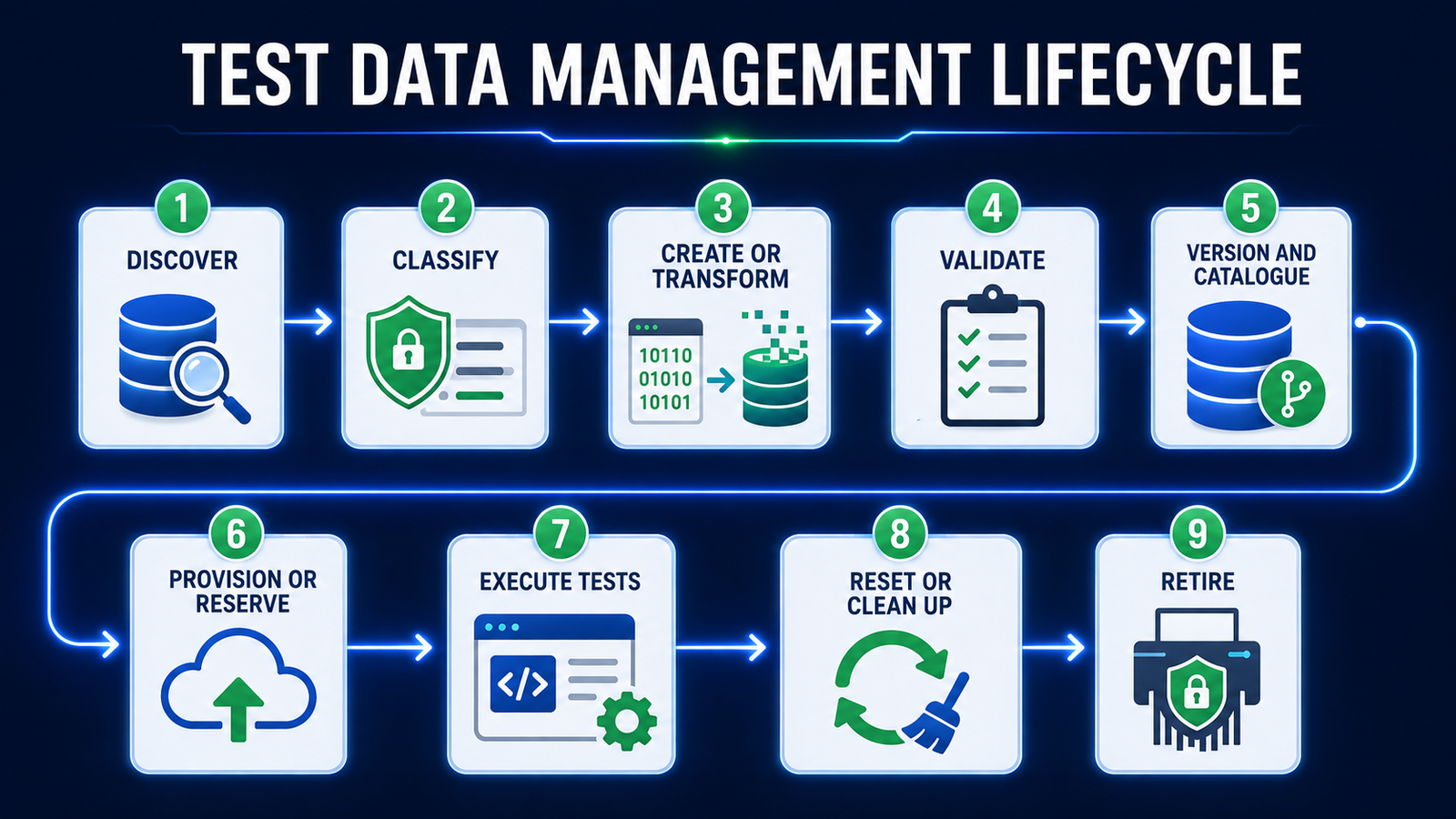
Test data management should be treated as a lifecycle, Each stage solves a different problem.
1. Discover
Identify the data required by the test.
That includes more than database tables.
A modern application may depend on:
- relational databases;
- document databases;
- event streams;
- object storage;
- message queues;
- files;
- third-party APIs;
- caches;
- search indexes;
- identity systems;
- feature flags.
A checkout scenario may require consistent data across customer, order, inventory, payment, promotion and notification systems.
2. Classify
Determine what kind of information the dataset contains.
Typical classifications include:
- public;
- internal;
- confidential;
- personal;
- financial;
- regulated;
- secret;
- credential-related.
Classification influences whether the data can be copied, masked, generated or stored in a particular environment.
3. Create or transform
Choose how the data will be produced.
Common methods include:
- manual fixtures;
- programmatic data factories;
- API-created data;
- masked production subsets;
- synthetic generation;
- database snapshots;
- virtualised copies.
Different test layers may use different techniques.
4. Validate
A dataset should not be accepted merely because it loaded successfully.
Validation should check:
- schema compatibility;
- required fields;
- unique constraints;
- foreign-key relationships;
- business rules;
- expected distributions;
- privacy rules;
- scenario completeness;
- absence of credentials or secrets;
- data volume;
- reproducibility.
A structurally valid customer record can still be semantically invalid.
For example, a customer may have an active subscription whose cancellation date is earlier than its activation date.
5. Version and catalogue
Every reusable dataset should have identifiable metadata.
At minimum, record:
- dataset version;
- schema version;
- creation method;
- generator version;
- source date;
- owner;
- supported scenarios;
- privacy classification;
- expiry date;
- cleanup policy.
This allows teams to understand what they are using and reproduce earlier results.
6. Provision or reserve
The required dataset must be delivered to the test.
Provisioning may involve:
- starting a disposable database;
- loading a snapshot;
- running a seeding script;
- creating data through APIs;
- requesting a virtual copy;
- assigning a test tenant;
- reserving existing records.
Parallel execution may require each run to receive its own namespace or reservation token.
7. Execute
During execution, tests should record the data context that matters.
Useful evidence includes:
- dataset version;
- customer or scenario identifier;
- generated-data seed;
- environment identifier;
- database snapshot;
- tenant;
- reservation token.
Without this evidence, reproducing a failure can become guesswork.
8. Reset or clean up
Tests must leave the system in a predictable state.
Possible strategies include:
- transaction rollback;
- deleting created entities;
- restoring a snapshot;
- rewinding a virtual copy;
- truncating selected tables;
- destroying the database;
- deleting the test tenant;
- time-to-live cleanup.
Cleanup should still run when tests fail or time out.
9. Retire
Old test datasets should not remain indefinitely.
Retirement includes:
- deleting expired datasets;
- revoking access;
- removing old snapshots;
- destroying orphaned environments;
- rotating secrets;
- archiving required evidence;
- updating catalogues.
Uncontrolled test data is both a cost and a security risk.
Six Ways to Create and Deliver Test Data
There is no universally best test data technique.
The correct choice depends on:
- test layer;
- team size;
- application architecture;
- privacy requirements;
- required fidelity;
- execution frequency;
- data volume;
- budget;
- CI/CD maturity.
Most teams use a combination of methods.
1. Hand-Written Fixtures
Fixtures are predefined data records stored in code, files, scripts or framework configuration.
Example:
{
  "customerId": "customer-expired-001",
  "subscriptionStatus": "EXPIRED",
  "paymentStatus": "FAILED",
  "country": "IN"
}
Advantages
- simple;
- transparent;
- easy to review;
- deterministic;
- version-controlled;
- fast to load;
- suitable for narrow scenarios.
Limitations
- expensive to maintain as schemas change;
- limited scenario coverage;
- relationships can become difficult to manage;
- often duplicated across tests;
- can drift away from production behaviour.
Best use
Fixtures work well for:
- unit tests;
- component tests;
- small integration tests;
- stable reference data;
- highly specific known scenarios.
They are less suitable for complex enterprise data graphs or large-volume performance tests.
2. Data Factories
A data factory creates test data programmatically.
Instead of storing a complete customer record, tests request a scenario:
createCustomer(
    subscription = "EXPIRED",
    invoices = 2,
    paymentMethod = "INVALID"
)
Factories may be implemented with:
- Java builders;
- Python functions;
- JavaScript or TypeScript utilities;
- Faker libraries;
- API clients;
- database helpers.
Advantages
- flexible;
- reusable;
- easy to integrate with automation;
- supports unique data per test;
- can create boundary values;
- works well with CI/CD.
Limitations
- requires engineering effort;
- business rules must be maintained;
- unconstrained randomness can create invalid records;
- complex relationships may require substantial code;
- generated data can diverge from real behaviour.
Best use
Factories are ideal for:
- automation engineers;
- startups;
- API testing;
- UI test setup through backend APIs;
- deterministic scenario creation;
- isolated parallel execution.
The key is to build domain-specific factories rather than generate random values blindly.
3. API-Created Test Data
Some teams create test data through application APIs.
For example, a test may call:
- customer creation API;
- subscription activation API;
- invoice creation API;
- payment failure simulator;
- permission assignment API.
Advantages
- uses real business workflows;
- avoids direct database manipulation;
- keeps test setup closer to application behaviour;
- useful for manual testers adopting automation;
- easier to expose as reusable scenario builders.
Limitations
- setup can be slow;
- APIs may not support all required states;
- generating historical states can be difficult;
- failures in setup APIs block the actual test;
- tests may spend more time creating data than validating behaviour.
Best use
API-created data is valuable when:
- the application exposes stable setup endpoints;
- direct database access is restricted;
- business rules must be enforced;
- teams need readable scenario builders.
A useful improvement is to create named templates such as:
customer_with_expired_card
customer_with_pending_refund
admin_without_export_permission
order_ready_for_partial_cancellation
These templates allow testers to request meaningful business states rather than assemble raw fields.
4. Masked Production Subsets
A masked subset uses selected production-derived records after sensitive information has been transformed.
A useful subset should preserve complete business relationships.
Selecting 1,000 customer rows is not enough if related accounts, orders, invoices, payments and events are missing.
Advantages
- realistic relationships;
- realistic distributions;
- real historical complexity;
- useful for regression and migration testing;
- can expose messy states that factories do not model.
Limitations
- privacy and re-identification risk;
- masking rules require maintenance;
- subsets may break referential integrity;
- production biases and poor-quality data are preserved;
- extraction can be slow;
- rare future scenarios may still be absent.
Best use
Masked subsets are useful when testing depends on:
- realistic production relationships;
- complex legacy data;
- migration behaviour;
- reporting;
- large relational systems;
- historical data patterns.
However, production-derived data should be used only when the required fidelity cannot be achieved safely through simpler methods.
5. Synthetic Test Data
Synthetic data consists of newly created records produced through rules, algorithms or statistical models.
It may be:
- rule-based;
- random;
- deterministic;
- model-based;
- AI-generated;
- distribution-aware.
The open-source Synthetic Data Vault is one example of a framework for generating synthetic tabular and relational data.
Advantages
- does not require direct reuse of production records;
- can generate large volumes;
- supports deliberate edge cases;
- useful for new features without production history;
- can create controlled combinations;
- can support performance and simulation workloads.
Limitations
- generated data may look realistic while violating business rules;
- rare production behaviour may be lost;
- model-based data can preserve unwanted bias;
- privacy leakage remains possible;
- relationships may be invalid;
- validation can require significant effort.
The US National Institute of Standards and Technology provides a privacy-enhancing technologies testbed that evaluates synthetic data across privacy, utility and fidelity.
That is an important principle.
Synthetic data should not be judged only by whether it looks realistic.
It must be evaluated for:
- privacy;
- usefulness;
- fidelity;
- business validity;
- relationship integrity;
- reproducibility.
Best use
Synthetic data is useful for:
- new product features;
- large-volume testing;
- controlled edge cases;
- AI system evaluation;
- simulation;
- privacy-sensitive environments;
- data-hungry performance tests.
6. Data Virtualisation
Data virtualisation in TDM generally creates lightweight, rapidly provisioned copies or views of an existing data source.
Teams may use it to:
- create multiple test environments;
- bookmark a data state;
- rewind after execution;
- provision copies quickly;
- reduce physical storage duplication.
Advantages
- fast provisioning;
- efficient storage;
- rapid reset and rewind;
- supports parallel environments;
- useful for large enterprise databases.
Limitations
- platform complexity;
- infrastructure dependency;
- potential vendor lock-in;
- source data still requires privacy controls;
- not always cost-effective for smaller teams.
Virtualisation makes data delivery faster.
It does not automatically make data safe.
If the source contains sensitive information, masking and access control are still required.
Test Data Masking vs Synthetic Data
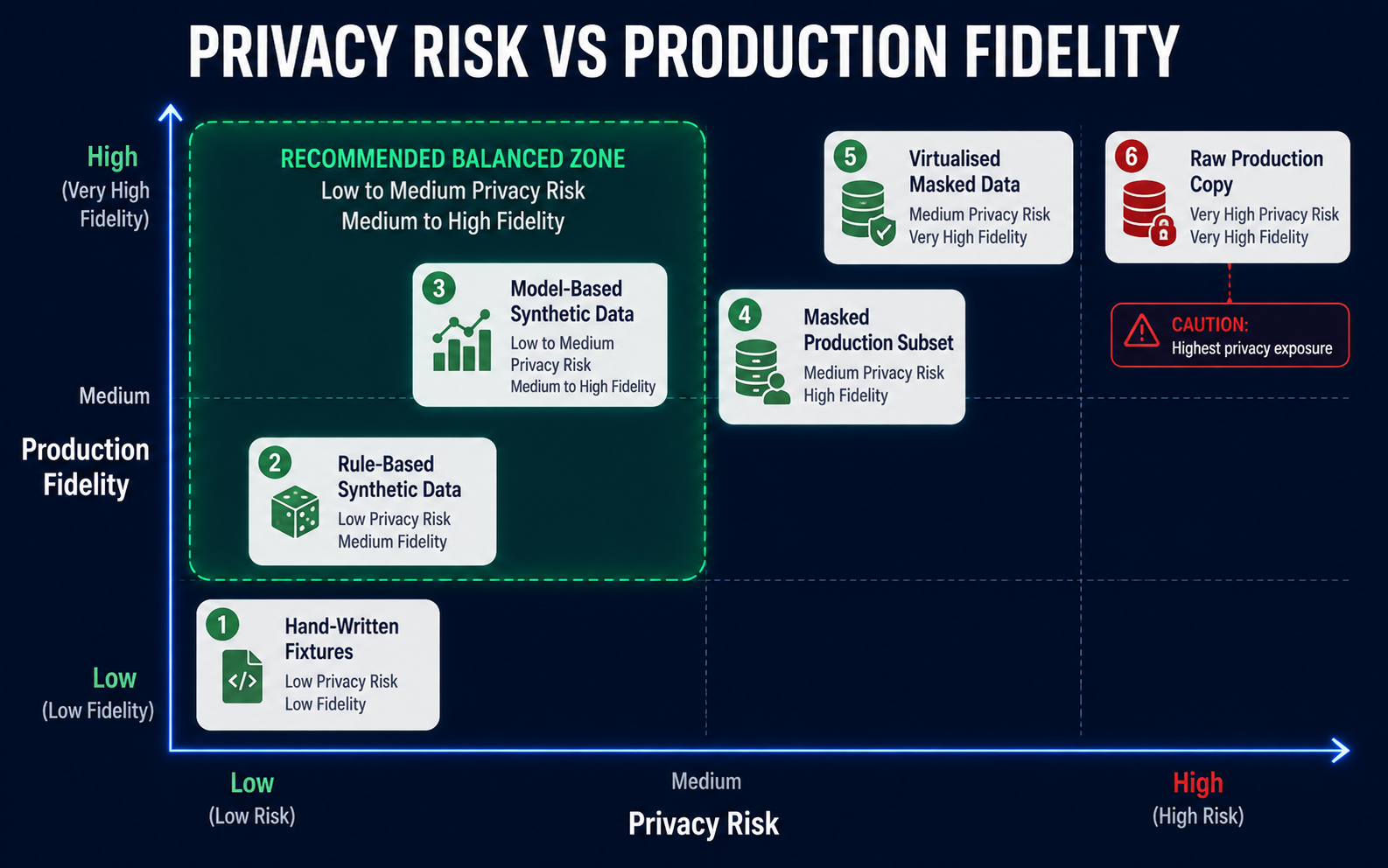
Masking and synthetic generation are often treated as interchangeable.
They are not.
| Criterion | Masked production data | Synthetic test data |
|---|---|---|
| Source | Existing production-derived records | Newly generated records |
| Real-world relationships | Usually strong if correctly preserved | Depends on rules or model quality |
| Privacy risk | Can remain significant | Can be lower, but not automatically zero |
| Edge-case control | Limited to source unless modified | High when rules are explicit |
| Rare scenarios | May already exist | Can be deliberately generated |
| Reproducibility | Strong with versioned subsets | Strong with fixed version and seed |
| Schema maintenance | Masking rules must track changes | Generators and constraints must track changes |
| Production bias | Preserved | May be reproduced by a model |
| New-product testing | Limited without production history | Strong fit |
| Migration testing | Often strong | May lack undocumented legacy behaviour |
Choose masked data when:
- real relationships are essential;
- production complexity cannot be modelled economically;
- migration or reporting behaviour must be validated;
- the organisation can manage privacy and governance correctly.
Choose synthetic data when:
- production-derived data is not allowed;
- you need specific edge cases;
- the feature is new;
- large volumes are required;
- scenario control matters more than exact production history.
Use both when:
- reference and configuration data need realistic production values;
- customer and transaction data should remain synthetic;
- rare scenarios must be deliberately generated;
- production-like distributions are required without copying identifiable records.
Important: Masked data is not automatically anonymous, and synthetic data is not automatically private or correct.
The UK Information Commissioner’s Office explains in its anonymisation and pseudonymisation guidance that pseudonymised information may still be personal data when it can be connected back to an individual.
Deterministic Test Data: The Missing Requirement
Many teams focus on realistic test data.
They should also focus on reproducible test data.
A failed test is difficult to investigate when the data cannot be recreated.
Consider this generator:
const customer = {
  age: randomNumber(18, 90),
  balance: randomNumber(-5000, 100000),
  country: randomCountry(),
  plan: randomPlan()
};
The generator may create broad variation.
But when the test fails, the exact customer state may be lost.
A better approach is to use a known seed:
const seed = process.env.TEST_DATA_SEED || "checkout-refund-2026-001";

const customer = generateCustomer({
  seed,
  ageRange: [18, 90],
  balanceRange: [-5000, 100000],
  supportedCountries: ["IN", "US", "GB"],
  requiredPlan: "PREMIUM"
});
The test report should store:
- seed;
- generator version;
- dataset version;
- schema version;
- scenario identifier;
- environment identifier.
Example:
Scenario: checkout-refund-2026-001
Dataset version: customer-domain-v3.4
Generator version: 2.8.1
Schema version: 2026.08.05
Seed: 984521
Environment: ci-run-72419
With this information, an engineer can recreate the same state.
Determinism does not mean eliminating randomness
Controlled randomness is useful for:
- broader input variation;
- property-based testing;
- finding unexpected combinations;
- boundary exploration;
- fuzz testing.
The goal is not to avoid random generation.
The goal is to make it observable and repeatable.
A test is not reproducible unless its data state is reproducible.
A Practical Test Data Contract
A useful Testheon framework is the test data contract.
A test data contract documents the dataset a test or test suite expects.
Example:
contractVersion: 1.0

scenario:
  id: customer-expired-subscription
  owner: subscription-qa-team
  purpose: regression

schema:
  version: 2026.08

data:
  customer:
    status: ACTIVE
    country: IN

  subscription:
    status: EXPIRED
    expiredDaysAgo: 15

  invoice:
    count: 2
    paymentStatus: FAILED

privacy:
  classification: SYNTHETIC
  productionDerived: false

provisioning:
  method: API_FACTORY
  isolation: PER_TEST_RUN

reproducibility:
  generatorVersion: 3.1.0
  deterministicSeed: required

cleanup:
  method: DELETE_TENANT
  maximumLifetimeMinutes: 60
The contract makes expectations explicit.
It helps QA engineers, developers, data teams and platform teams agree on:
- required state;
- ownership;
- privacy classification;
- creation method;
- isolation;
- reproducibility;
- cleanup;
- expiry.
A modern QA engineering skill map increasingly includes this kind of systems thinking.
How to Manage Test Data in CI/CD
A mature CI/CD pipeline should treat test data as an explicit stage.
An illustrative pipeline may look like this:
stages:
  - validate-schema
  - create-environment
  - apply-migrations
  - provision-test-data
  - validate-test-data
  - run-tests
  - publish-results
  - destroy-environment
The exact implementation will vary, but the sequence is important.
Step 1: Validate the schema
Before generating or loading data, confirm that:
- migrations are available;
- required fields exist;
- generator rules match the schema;
- fixture versions are compatible;
- reference data is current.
Step 2: Create an isolated environment
Possible isolation levels include:
- database per pipeline;
- schema per pipeline;
- tenant per pipeline;
- namespace per test run;
- container per test class;
- virtual copy per branch.
Testcontainers is one widely used option for creating disposable databases and services during automated tests.
Its JDBC database support can start temporary database containers for test execution and remove them afterwards.
Step 3: Apply migrations
The test database should reflect the same migration path as the application build.
Skipping migrations and loading a prebuilt schema can hide upgrade defects.
Step 4: Provision data
Depending on the strategy, the pipeline may:
- run fixtures;
- call data factories;
- restore a snapshot;
- request a masked subset;
- generate synthetic data;
- call setup APIs.
Step 5: Validate the dataset
Before starting the test suite, verify:
- row counts;
- required entities;
- relationships;
- constraints;
- scenario identifiers;
- privacy rules;
- absence of secrets;
- expected versions.
Fail early if the dataset is invalid.
It is better to stop during provisioning than allow hundreds of tests to fail with misleading errors.
Step 6: Execute tests
Provide the test with:
- connection details;
- tenant identifier;
- scenario identifier;
- namespace;
- dataset version;
- reservation token;
- seed.
Step 7: Publish evidence
Include test data metadata in reports.
This dramatically improves failure investigation.
Step 8: Destroy or reset
Cleanup must run even when:
- assertions fail;
- the process crashes;
- a test times out;
- the pipeline is cancelled.
Use:
- guaranteed teardown hooks;
- infrastructure cleanup jobs;
- time-to-live policies;
- orphan detection;
- scheduled janitors.
Preventing Test Data Collisions in Parallel Execution
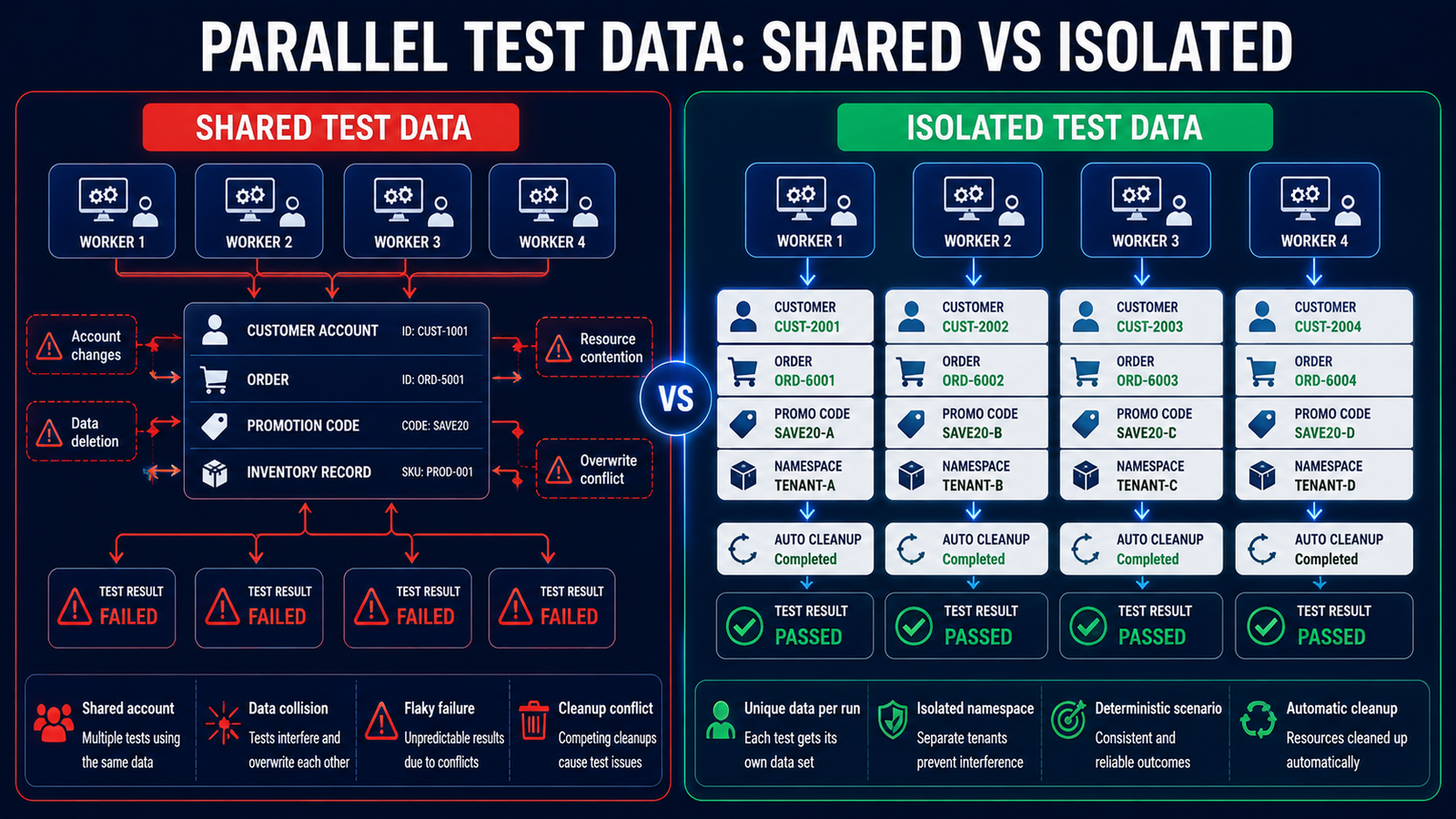
Parallel testing exposes weaknesses that serial suites hide.
Before isolation
Imagine four workers running checkout tests.
All use:
customer_id = 1001
promotion_code = SAVE20
product_inventory = 1
Possible sequence:
- Worker A uses
SAVE20. - Worker B attempts to use the same single-use code.
- Worker C purchases the final product.
- Worker D validates inventory availability.
- Worker A deletes the customer during cleanup.
- Workers B, C and D fail.
The application may be behaving correctly.
The tests are interfering with each other.
After isolation
Each worker receives:
- unique customer;
- unique order;
- unique promotion;
- independent inventory allocation;
- separate namespace or tenant;
- cleanup ownership.
Example:
run-724-worker-1-customer
run-724-worker-2-customer
run-724-worker-3-customer
run-724-worker-4-customer
Isolation strategies
Use one or more of these patterns:
Unique identifiers
Include the test run and worker ID in generated values.
qa+run724-worker3@testheon.exampleNamespace per run
All records created by the run share a unique namespace.
Tenant per run
Multi-tenant applications can create a disposable tenant for each pipeline.
Reservation system
Tests request and lock an existing data entity.
The reservation should include:
- owner;
- expiry;
- purpose;
- release status.
Database per run
Use an isolated disposable database for high-value integration suites.
Transaction rollback
For supported test layers, execute the test inside a transaction and roll back afterwards.
Time-to-live cleanup
Every temporary record should have an expiry policy in case normal cleanup fails.
Measure collision rate
Track:
Number of test runs affected by unexpected shared-data interference
÷
Total parallel test runs
A rising collision rate is a sign that the suite has outgrown shared static data.
Privacy and Security in Test Data Management
Privacy controls should be designed before data enters a lower environment.
Do not rely only on access restrictions after the data has already been copied.
Minimise data
Use only the minimum data required for the test.
A performance test may need data volume, but it may not need actual names, phone numbers or documents.
Remove credentials and secrets
Test datasets should be scanned for:
- passwords;
- API tokens;
- encryption keys;
- private certificates;
- session tokens;
- access keys;
- internal URLs;
- authentication cookies.
Preserve relationships safely
Masking must be consistent.
Suppose customer ID C1021 appears in:
- customer database;
- billing system;
- order service;
- analytics store;
- event history.
Replacing each occurrence independently may break the scenario.
Use deterministic mappings so that every occurrence is transformed consistently.
Protect test artefacts
Sensitive data can also leak through:
- screenshots;
- logs;
- network traces;
- videos;
- HTML reports;
- exported CSV files;
- defect attachments.
Test data protection must include test evidence, not only databases.
Define retention
Every dataset should have:
- creation date;
- owner;
- purpose;
- expiry;
- deletion method.
Review AI-assisted generation
AI tools can help propose:
- edge cases;
- field combinations;
- invalid states;
- schema examples;
- synthetic records.
But AI-generated output should be treated as untrusted.
Validate it against:
- schema;
- business rules;
- referential constraints;
- privacy rules;
- distribution expectations;
- test oracles.
Avoid sending raw production samples to unapproved AI services.
The DORA research programme has repeatedly emphasised that AI tends to amplify the engineering system around it. Weak validation and unclear processes do not become strong merely because AI is introduced.
Compliance caution
No masking tool, synthetic data platform or TDM product makes a system automatically compliant.
Compliance depends on:
- jurisdiction;
- data type;
- lawful use;
- technical controls;
- organisational processes;
- access;
- retention;
- monitoring;
- contracts;
- risk assessment.
OWASP also warns that non-production resources such as test endpoints, logs, sample data and debug functionality can create security exposure.
Reference Architecture for Modern Test Data Management
A modern TDM architecture can be understood as ten layers.
1. Source systems
Possible sources include:
- production-like databases;
- schema definitions;
- event stores;
- data warehouses;
- APIs;
- files;
- reference datasets.
2. Discovery and classification
This layer identifies:
- personal data;
- financial data;
- regulated data;
- credentials;
- secrets;
- business-sensitive information.
3. Transformation
The transformation layer may:
- mask;
- tokenise;
- subset;
- synthesise;
- age;
- perturb;
- remove;
- generalise values.
4. Relationship engine
This layer preserves relationships across:
- tables;
- databases;
- microservices;
- events;
- documents;
- business entities.
Without it, transformed data may become unusable.
5. Dataset catalogue
The catalogue stores:
- dataset ID;
- version;
- provenance;
- supported scenarios;
- schema;
- owner;
- privacy status;
- expiry;
- usage restrictions.
6. Provisioning service
The provisioning service exposes:
- API;
- command-line interface;
- CI/CD integration;
- self-service portal;
- workflow automation.
7. Reservation and namespace layer
This prevents teams or test workers from modifying the same logical records.
8. Test execution integration
Automation frameworks receive the data through:
- environment variables;
- API responses;
- configuration files;
- secrets manager;
- test hooks;
- fixture injection.
9. Reset and retirement
This layer handles:
- deletion;
- rollback;
- rewind;
- snapshot restore;
- destruction;
- retention;
- time-to-live cleanup.
10. Governance and observability
The final layer tracks:
- access;
- creation;
- usage;
- failures;
- drift;
- cleanup;
- cost;
- privacy exceptions;
- provisioning time.
This turns test data into an observable service rather than an invisible dependency.
What Test Data Management Looks Like at Different Team Sizes
The correct TDM strategy depends heavily on organisational scale.
Small startup
Situation
- five to ten engineers;
- one primary database;
- limited budget;
- automated tests run in CI;
- shared staging causes collisions.
Recommended approach
- data factories;
- deterministic fixtures;
- API-based builders;
- disposable database for integration tests;
- unique identifiers per test run;
- scheduled cleanup.
Avoid
- purchasing a complex enterprise platform too early;
- copying the entire production database;
- building a central TDM organisation before the need exists.
Mid-sized engineering organisation
Situation
- multiple services;
- shared regression environments;
- nightly automation;
- manual database refresh requests;
- personal data in production;
- multiple QA teams.
Recommended approach
- approved masked subsets;
- synthetic edge-case data;
- provisioning API;
- dataset catalogue;
- per-run namespace;
- central masking rules;
- measurable service-level targets.
Key risk
Each service may mask or generate identities differently, breaking cross-system relationships.
Enterprise QA organisation
Situation
- many databases and business systems;
- mainframe or legacy dependencies;
- regional teams;
- regulated information;
- long provisioning times;
- significant storage cost;
- many parallel environments.
Recommended approach
- central classification;
- policy-driven masking;
- business-entity subsetting;
- virtual copies;
- self-service provisioning;
- reservation;
- audit;
- access control;
- lifecycle governance;
- platform APIs.
Key risk
The organisation may buy a large tool before defining ownership, policies and adoption responsibilities.
Manual testers adopting automation
Situation
Testers create customers, orders and accounts through the UI before every test.
Recommended approach
Create approved scenario builders exposed through:
- simple APIs;
- forms;
- command-line tools;
- low-code workflows;
- reusable automation keywords.
Example:
Create customer with expired subscription
Create order eligible for partial refund
Create user without export permission
This allows manual testers to use automation-friendly data without writing raw SQL.
AI-assisted testing team
Situation
The team uses AI to propose data combinations and edge cases.
Recommended approach
- provide redacted schema context;
- use approved AI services;
- validate every output;
- require deterministic conversion into code;
- track model and prompt version where relevant;
- review privacy and retention;
- add generated scenarios to the formal data catalogue.
See the broader Testheon guide to AI testing tools for QA engineers for additional AI-assisted testing considerations.
When Is a Test Data Management Tool Worth the Cost?
A commercial TDM platform may be justified when the organisation needs several of the following:
- many data sources;
- complex cross-system relationships;
- consistent enterprise masking;
- self-service provisioning;
- data virtualisation;
- rapid reset;
- strong governance;
- audit trails;
- role-based access;
- large data volumes;
- many parallel teams;
- regional deployment;
- regulatory controls;
- central policy enforcement.
Questions to ask before buying
Data-source support
- Does the platform support every required database and version?
- Does it support files, events, SaaS platforms and unstructured data?
Referential integrity
- Can it preserve identities across systems?
- Can it subset complete business entities?
Masking
- Are transformations deterministic?
- Are they format-preserving?
- Can they be tested automatically?
- Can rules be versioned?
Synthetic data
- Can it preserve multi-table relationships?
- Can it enforce business constraints?
- Can it generate rare scenarios?
- How is privacy evaluated?
Provisioning
- Does it provide a documented API and command-line interface?
- Is it idempotent?
- Can it integrate with CI/CD?
- Can it create and destroy datasets automatically?
Security
- Does it support SSO?
- Is role-based access available?
- Are audit logs complete?
- Can it run in the required deployment model?
Observability
- Can you measure provisioning time?
- Can you track failures and cleanup?
- Can you identify stale datasets?
- Can you monitor usage and cost?
Lock-in
- Can you export rules, metadata, mappings and datasets?
- What happens if the organisation changes vendors?
Pricing
Ask what drives the price:
- data volume;
- number of sources;
- number of users;
- environments;
- connectors;
- generated records;
- API requests;
- professional services;
- support level.
When not to buy a platform
A commercial platform may be unnecessary when:
- the team has one simple database;
- factories already provide sufficient coverage;
- isolation can be achieved with disposable databases;
- only a few pipelines require data;
- privacy-sensitive production data is not used;
- the organisation cannot maintain the platform;
- no one owns TDM governance.
A five-person team should not buy an enterprise solution to solve a fixture-maintenance problem.
Start with the simplest approach that satisfies the risk.
Metrics That Prove Test Data Management Is Working
Avoid measuring only test execution time.
TDM influences work before, during and after execution.
Test-data lead time
Median time between a valid request and delivery of usable test data.
Data-ready pipeline rate
Percentage of pipelines where required data is available before execution begins.
Data-related failure rate
Percentage of test failures caused by:
- missing data;
- stale data;
- shared data;
- invalid data;
- cleanup failure;
- wrong scenario state.
Collision rate
Percentage of parallel runs affected by unexpected shared-data interference.
Reproduction success rate
Percentage of failed tests successfully recreated using the stored:
- seed;
- dataset version;
- schema version;
- scenario identifier.
Reset success rate
Percentage of environments returned to the required baseline after execution.
Referential-integrity defect rate
Number of provisioned datasets that fail relationship checks.
Sensitive-data exception count
Number of approved exceptions where raw or reversibly transformed production data exists in lower environments.
Edge-case coverage
Percentage of required business-state and boundary scenarios available in the dataset catalogue.
Dataset drift
Difference between approved test datasets and the current production:
- schema;
- rules;
- distributions;
- reference values.
Orphaned-data volume
Number of entities or environments that survive beyond their intended lifetime.
Metrics help QA leads demonstrate that test data is an engineering capability, not invisible preparation work.
That shift is part of the broader move towards QA engineers leading quality systems.
Common Test Data Management Mistakes
| Mistake | Why it happens | Consequence | Better approach |
|---|---|---|---|
| Copying raw production data | It appears to provide instant realism | Privacy exposure and uncontrolled retention | Synthetic by default; otherwise minimise and transform before delivery |
| Assuming masked data is anonymous | Teams focus only on removed names | Residual re-identification risk | Perform realistic identifiability analysis |
| Using uncontrolled random data | Random libraries are easy to use | Invalid and irreproducible failures | Use domain constraints and recorded seeds |
| Sharing accounts between tests | Suites were originally serial | Parallel collisions and flaky tests | Use unique entities, reservation or isolation |
| Cleaning only after successful tests | Teardown runs after assertions | Crashes leave stale data | Guaranteed teardown plus time-to-live cleanup |
| Masking fields independently | Transformation is designed per column | Broken relationships across systems | Use consistent deterministic mappings |
| Maintaining one golden database forever | Stable data feels convenient | Schema and scenario drift | Version datasets and define refresh triggers |
| Creating only happy-path records | Data is based on demos | Edge cases remain untested | Maintain an explicit scenario catalogue |
| Sending raw samples to AI tools | AI generation appears faster | Privacy, retention and confidentiality risk | Use approved tools and redacted inputs |
| Buying tools before defining ownership | Product demos focus on features | Low adoption and unclear governance | Define process, roles and metrics first |
| Measuring only execution duration | Preparation is outside the runner | TDM delays remain invisible | Measure lead time, collisions and reproduction |
| Assuming more realism is always better | Production similarity feels valuable | Large slow datasets without targeted coverage | Use minimum viable fidelity |
The Testheon Test Data Management Maturity Model
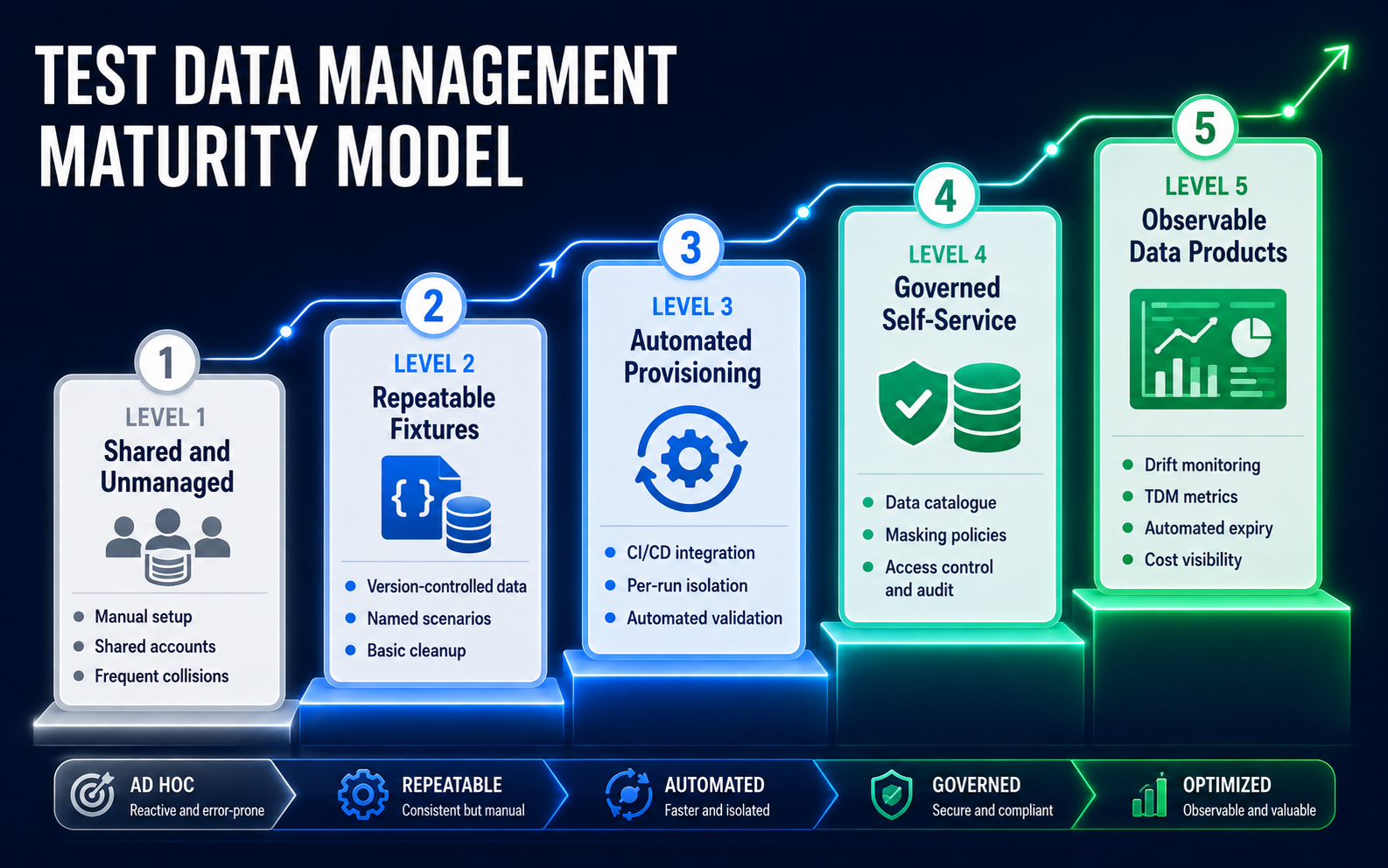
Teams can assess their maturity across five levels.
Level 1: Shared and unmanaged
Characteristics:
- shared staging accounts;
- manual data creation;
- production copies;
- undocumented scripts;
- frequent collisions;
- inconsistent cleanup.
Primary goal:
Gain visibility.
Identify data sources, risks, owners and recurring failures.
Level 2: Repeatable fixtures
Characteristics:
- version-controlled fixtures;
- basic data builders;
- named scenarios;
- some deterministic setup;
- documented cleanup.
Primary goal:
Improve reproducibility.
Record dataset versions and eliminate uncontrolled shared accounts.
Level 3: Automated provisioning
Characteristics:
- API or pipeline-based data creation;
- per-run namespaces;
- automated validation;
- automated teardown;
- disposable environments;
- stored seeds and scenario IDs.
Primary goal:
Remove manual waiting.
Make test data available as part of CI/CD.
Level 4: Governed self-service
Characteristics:
- masking policies;
- dataset catalogue;
- role-based access;
- self-service provisioning;
- service-level targets;
- privacy classification;
- data reservations;
- audit logs.
Primary goal:
Scale safely across teams.
Level 5: Observable test data products
Characteristics:
- measurable lead time;
- collision monitoring;
- drift detection;
- reusable data contracts;
- quality scoring;
- automated expiry;
- cost visibility;
- business-owned data products;
- policy-driven provisioning.
Primary goal:
Treat test data as a managed engineering service.
Most teams do not need to reach Level 5 immediately.
The next maturity level should solve a measured problem, not become a transformation programme for its own sake.
A Practical 30-Day Test Data Management Plan
You do not need to solve every TDM problem at once.
Start with one painful, high-value workflow.
Week 1: Audit the current state
Identify:
- top ten data-related test failures;
- most frequently reused shared accounts;
- environments using production-derived data;
- manual data requests;
- average wait time;
- cleanup failures;
- missing edge cases;
- teams and systems involved.
Deliverables:
- source inventory;
- privacy classification;
- failure baseline;
- ownership list;
- pilot test suite.
Choose a pilot where data problems are visible and measurable.
Week 2: Design the target approach
Define:
- required scenarios;
- creation method;
- privacy rules;
- isolation level;
- dataset metadata;
- cleanup method;
- expected provisioning time;
- success metrics.
Create initial test data contracts.
Decide whether the pilot uses:
- factories;
- API builders;
- masked subset;
- synthetic data;
- disposable database;
- hybrid approach.
Week 3: Automate provisioning and cleanup
Implement:
- pipeline stage;
- environment or namespace creation;
- migrations;
- data generation or loading;
- validation;
- seed recording;
- scenario identifiers;
- test execution;
- guaranteed cleanup.
Fail the pipeline early when data validation fails.
Do not allow hundreds of tests to run against a broken dataset.
Week 4: Measure and improve
Compare the pilot against the baseline.
Measure:
- preparation time;
- data-related failures;
- collision rate;
- reproduction rate;
- cleanup success;
- tester effort;
- infrastructure cost.
Document:
- what worked;
- what remained manual;
- missing scenarios;
- policy gaps;
- next automation target.
Then expand gradually.
A successful pilot is more valuable than a large TDM programme that never reaches everyday test execution.
Test Data Management Best-Practice Checklist
Before calling your test data process mature, confirm that:
- test data requirements are documented;
- production data is not copied by default;
- sensitive data is classified;
- masking rules preserve required relationships;
- generated data follows business constraints;
- random data can be reproduced;
- dataset and schema versions are recorded;
- parallel tests receive isolated or reserved data;
- cleanup runs after failures;
- temporary data has an expiry policy;
- logs and reports do not expose sensitive values;
- test data drift is reviewed;
- ownership is clear;
- provisioning time is measured;
- data-related failures are tracked;
- every commercial tool has an exit strategy.
Frequently Asked Questions
What is test data management in software testing?
Test data management is the controlled process of creating, sourcing, transforming, validating, provisioning, isolating, maintaining and deleting data used in software testing. It covers the complete data lifecycle rather than only data generation.
Why should QA teams avoid copying production data?
Production data may contain personal, confidential, financial, regulated or credential-related information. Lower environments often have weaker controls and broader access. When production-derived data is genuinely necessary, teams should minimise, transform, restrict, monitor and delete it according to defined policies.
What is the difference between test data masking and synthetic data?
Masking transforms values from source-derived data while attempting to preserve required structure and relationships. Synthetic data creates new records using rules, algorithms or statistical models. Masked data often has stronger production fidelity, while synthetic data provides greater scenario control.
Is masked data anonymous?
Not necessarily. Data may remain linkable to an individual or organisation even after obvious identifiers have been removed. Whether data is effectively anonymised depends on re-identification risk, available additional information and the transformation method.
Is synthetic data always safe?
No. Synthetic data can contain unrealistic relationships, reproduce sensitive patterns, preserve bias or leak information from training samples. It must be evaluated for privacy, utility, fidelity and business validity.
How does test data management fit into CI/CD?
The pipeline should create or select an isolated environment, apply migrations, provision and validate a versioned dataset, run tests, record data evidence, and reliably reset or destroy the environment after execution.
How can generated test data remain reproducible?
Record the dataset version, generator version, schema version, deterministic seed and scenario identifier. These values allow the same state to be regenerated when a failure needs investigation.
How can teams prevent parallel tests from changing each other’s data?
Use unique identifiers, per-run namespaces, disposable databases, isolated tenants, reservation systems or virtual copies. Shared mutable accounts should be avoided in parallel test suites.
Does a startup need an enterprise TDM platform?
Usually not. A small team can often solve its immediate problems using fixtures, domain factories, setup APIs, deterministic seeds and disposable test databases. Enterprise platforms become more valuable as data sources, privacy risks, team concurrency and governance requirements increase.
Can AI generate test data?
Yes. AI can suggest edge cases, create sample records and help explore combinations. However, AI output should be validated against schema, business rules, relationships, privacy controls and test oracles. Sensitive data should not be sent to unapproved services.
Final Thoughts: Treat Test Data as Part of the Test System
Test data management is sometimes treated as an enterprise database problem.
It is not.
It affects any team that has experienced:
- flaky tests;
- shared-account collisions;
- slow setup;
- privacy concerns;
- missing scenarios;
- difficult failure reproduction;
- stale staging data;
- unreliable cleanup.
The solution is not always a large platform.
It may begin with:
- a deterministic data factory;
- a disposable database;
- a unique namespace;
- a documented scenario;
- a reliable cleanup hook;
- a stored random seed.
As systems grow, those practices can evolve into governed self-service provisioning, masking, synthetic generation, virtualisation and observable test data products.
The principle remains the same:
Treat test data as part of the test system—not as preparation work performed before testing begins.
When data is versioned, isolated, validated and reproducible, automation becomes more trustworthy.
Failures become easier to investigate.
Teams spend less time waiting.
And QA engineers move from managing test inputs to designing quality systems.
Continue the QA in the Age of AI Series
Previous: AI testing tools for QA engineers
Part 5: Test Data Management 2026: A Complete Guide for QA Engineers
Next: Security Testing for QA Engineers — coming soon