
QA skills 2026 mark a clear dividing line in the profession. On one side: engineers still doing work the way they did in 2022. On the other: engineers who have figured out that their judgment, paired with AI, now multiplies their output far beyond what any single person could achieve by hand. This post maps exactly how to get to the second side.
Let’s start with the fear, because you’ve felt it. Every QA engineer has had the same 2am thought: “AI is going to automate my job.” You’ve watched tools generate test cases in seconds. You’ve seen a language model write a Playwright script faster than you could open your IDE. And somewhere in the back of your mind, a quiet voice asked whether you’re training your own replacement.
Here’s the truth that voice doesn’t know: AI isn’t replacing QA engineers. It’s replacing QA engineers who refuse to use AI with QA engineers who do.
And the second group? They’re not working harder. They’re working with leverage most people haven’t figured out yet. One skilled engineer, paired with the right AI systems, is quietly doing what used to take an entire team. Not because they’re superhuman. Because they finally stopped doing the work that machines do well, and doubled down on the work only they can do.
This post is the map for your QA skills upgrade. It shows you exactly which of your existing skills become superpowers when combined with AI and how to stop being one tester on a team and start being the person who drives the entire quality function end to end.
You already have more of what you need than you think.
The Mental Model: You’re Not Replacing Yourself — You’re Multiplying Your QA Skills
Before the skill map, internalize this, because everything depends on it.
Old QA career math looked like addition. Learn one more tool, run a few more tests, cover a bit more ground. Linear. Slow. Exhausting.
New QA career math is multiplication. Every skill you already have becomes an input you can point AI at, scaling its output far beyond what your hands alone could produce. You don’t test faster. You direct testing at a scale your hands never could.
The engineer who does the work of ten isn’t typing ten times faster. They’ve built a system where their judgment sets the direction and AI does the volume. Their skill isn’t execution anymore. It’s orchestration. That’s what strong QA skills actually look like.
So as you read each skill below, don’t ask “should I learn this?” Ask “how does this multiply when I hand the grunt work to a machine and keep the thinking for myself?”
The Four-Layer QA Skills 2026 Map
Think of your QA skills in four layers, from foundation to leverage. You build upward. Skip a layer and the ones above it collapse.

Layer 1 — The Foundation Skills (Keep These, They Just Got More Valuable)
There’s a myth going around that AI makes fundamentals obsolete. The opposite is true. When AI generates volume, the person who understands fundamentals becomes the only one who can tell good output from garbage. The core QA skills demands are rooted here.
Test design thinking. Boundary values, equivalence partitioning, decision tables, state transitions. AI can generate a thousand test cases. Only you can tell which twelve actually matter. This skill went from “nice to have” to “the thing that makes AI output usable.”
Understanding how software breaks. Race conditions, off-by-one errors, null handling, integration seams, timing issues. This intuition built from years of watching things fail is the exact knowledge AI lacks. It has read about bugs. You’ve been burned by them. That difference is your moat.
Reading and reasoning about code. You don’t need to write production code like a senior developer. But you need to read it fluently enough to know what deserves testing and why. In 2026 this is non-negotiable, and AI actually makes it easier to learn.
Debugging discipline. The methodical hunt from symptom to root cause. AI can suggest hypotheses, but someone has to run the investigation with judgment. That someone is you.
These aren’t the past. They’re the foundation the leverage sits on.
Layer 2 — The Automation Skills (Evolve These From Writing to Directing)
Here’s where the shift gets real. For a decade, automation meant writing automation. That era is closing. The new automation skill is directing automation.
From script author to script architect. You no longer need to write every line. You describe the intent, let AI draft the scaffolding, and you review, correct, and harden. Your value moves up the stack.
Framework literacy over framework memorization. You don’t need every Playwright or Cypress API memorized. AI recalls syntax instantly. What you need is to understand architecture: page objects, fixtures, parallelization, retry logic, reporting.
CI/CD fluency. This is the skill that separates testers from quality engineers. Understanding pipelines, gates, environments, and deployment flow lets you embed quality into the delivery process instead of bolting it on at the end. This is how you stop being downstream and start being inside the pipeline.
Test data and environment mastery. The unglamorous skill that quietly makes or breaks every automation effort. Own this and you become indispensable, because everyone else avoids it.
The engineer directing five AI-assisted suites across five services is doing what five engineers used to do writing by hand. Same person. Same brain. Radically different leverage.
Layer 3 — The AI-Native QA Skills 2026 (The New Layer — Learn These Now)
This is the layer that didn’t exist three years ago. It’s where the biggest gap — and therefore the biggest opportunity — lives right now in terms of QA skills.

Prompt engineering for testing. Vague prompts get generic tests. Precise prompts — with context about your system, your risks, your edge cases — get output you can actually ship. This is learnable in weeks and pays off immediately. Anthropic’s prompt engineering guide is a strong starting point for building this skill systematically.
AI-assisted test generation. Feed requirements, user stories, or code to a model and get first-draft test cases, then apply your judgment to refine them. The bottleneck stops being creation and becomes curation — which is faster and plays to your strengths.
Agentic AI orchestration. AI agents that can explore an application, generate tests, run them, analyze failures, and report back with you supervising rather than executing. The single highest-leverage skill emerging in QA today. The engineers who master it genuinely operate at a different scale.
Knowing where AI fails. AI can’t understand your business risk. It happily generates four hundred brittle tests that all break next sprint. Your job is to be the judgment layer. AI executes. QA judges. That’s the whole game.
Nobody has a decade of experience in these QA skills. That’s exactly why learning them now puts you years ahead. The playing field is level, and it won’t stay that way.
Layer 4 — The Leverage Skills (What Turns One Engineer Into Ten)
The top layer. These are the QA skills that convert everything below into outsized impact. Most engineers never reach here, because they’re stuck grinding execution. You won’t be.
Product knowledge. The multiplier that beats every tool. When you understand the product better than anyone on the team, your testing stops being reactive and starts being strategic. You catch the bugs that matter, not just the bugs that exist. Tools change every two years. Product knowledge compounds for a decade.
End-to-end ownership. You stop thinking “I test features” and start thinking “I own whether this product is correct, safe, fast, and shippable from commit to production.” You orchestrate quality across the entire cycle, with AI amplifying your reach at every stage.
Communication and influence. Being able to explain risk to leadership, advocate for quality in planning, and translate between developers and business. AI can draft the report. Only you can walk into the room and change the decision.
Systems thinking. Seeing the whole board. How services interact, where the real risk concentrates, what a change ripples into. This is the view that lets one person meaningfully own quality across an entire product.
When you combine Layer 4 with Layer 3, something remarkable happens. Your judgment gets applied at machine scale. That’s the engineer who does the work of ten — not through effort, but through leverage. That’s the full picture of QA skills in action.
What to Stop Spending Time On
Manual regression execution. If you’re still clicking through the same regression suite by hand every release, stop. Your hands are too expensive for this.
Writing boilerplate test scripts from scratch. Let AI draft. You edit. Writing every selector by hand in 2026 is like doing arithmetic when a calculator sits on your desk.
Memorizing tool syntax. You need to know what’s possible and let AI recall the exact syntax.
Exhaustive documentation nobody reads. Document decisions and risks. Skip ritual documentation that exists only to look busy.
Fighting AI on principle. The engineers who refuse AI entirely aren’t preserving craft — they’re volunteering to be outpaced. Use the tools. Keep the judgment. That’s the balance.
Your 90-Day QA Skills 2026 Learning Plan
Motivation without a plan is just a feeling. Here’s the concrete QA skills 2026 roadmap, one month at a time.
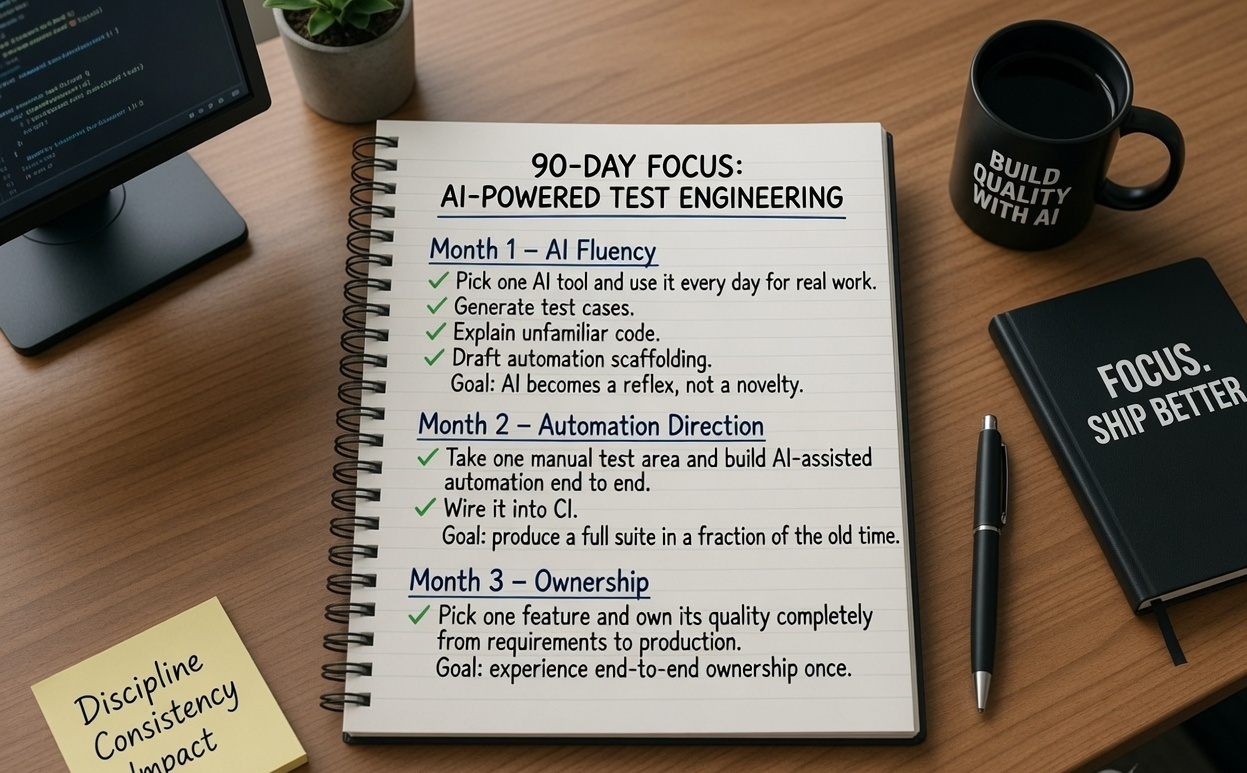
Pick one AI tool and use it every day for real work. Generate test cases. Explain unfamiliar code. Draft automation scaffolding. Goal: AI becomes a reflex, not a novelty.
Take one manual test area and build AI-assisted automation end to end. Wire it into CI. Goal: produce a full suite in a fraction of the old time.
Pick one feature and own its quality completely from requirements to production. Goal: experience what end-to-end ownership feels like, once.
Do this, and in ninety days your QA skills will be at a level most of your peers haven’t reached yet. You’ll feel the difference.
The Honest Truth
Nobody literally replaces ten humans with a keyboard and a chatbot. What actually happens: you stop spending your hours on work that never needed a human, and concentrate every hour on the judgment and product understanding that no machine can replicate. AI absorbs the volume. You supply the direction.
That’s not hype. That’s leverage. And the full QA skills stack — foundation, automation, AI-native, and leverage — is available to anyone willing to build it instead of clinging to execution alone.
You already have the foundation. Now go build the rest.
The Bottom Line
The QA skills 2026 map isn’t about abandoning who you are. It’s about taking the hard-won instincts you already have — how software breaks, what actually matters, where the real risk lives — and multiplying them through AI until your impact stops looking like one person’s.
Keep your fundamentals. Evolve your automation from writing to directing. Learn the AI-native layer while the field is still level. Climb to the leverage skills that turn all of it into end-to-end ownership.
The engineer who does the work of ten isn’t coming to take your job.
The engineer who does the work of ten is who you’re about to become.
This is Part 2 of the QA in the Age of AI series. Part 3 covers writing a test strategy that earns QA a seat at the decision-making table.
I write about building quality systems in the age of AI — test strategy, automation architecture, and how to grow as a QA engineer. Based in India.
Pingback: Test Strategy 2026: The Template That Finally Gets QA a Seat at the Table - Testheon